


Government secrecy in land tenders
9 November 2012
Webb-site noted last year that the HK Government has increasingly shied away from the open bidding of land auctions in favour of the sealed-envelope tender approach to sell sites. It probably stems from the fear of negative publicity if an auction fails to match a reserve price, or perhaps some fear of collusion if the bidders can see who else is bidding and somehow get together to rig a bid.
In tenders, the Government routinely announces the terms of the winning bid, but not the other bids. The Government also announces far less than it knows about who is behind the bids. Each tender form requires the bidder to name its "parent company", if any. This does not say "ultimate parent", so there is a risk that some shells would just name the immediate parent (the registered holder of the bidder's shares) which could just be another meaningless shell. However, most bidders comply with the spirit of this and name their top parent company. Take a look at a typical "Tender Notice and Form of Tender". On page 2 you will see Clause 6(c):
"After the award of the tender, the identity of the successful tenderer and the unsuccessful tenderers and their parent company (if any)... can be disclosed by the Government in response to public or media enquiries. The Government reserves the right to announce the said tender results without the need to seek the prior agreement of the tenderers and their parent company (if any)."
But the Government's announcements give false transparency - they list only the names of the bidders, which are usually just shell companies with names you have never heard of. Take this example, published on 24-May-2012, with the names of 24 bidders for 2 sites (including the winners). Doesn't mean much, does it? That's the only public written record of the sale. In practice, journalists call up the Lands Department, and ask who is behind the winner and sometimes the other bidders. This leaves no public record of the disclosure, just fragments in newspapers.
So Webb-site has, since March 2012, been writing to the Government every time we spot one of these announcements, and asking for the names of all the parent companies (if any). After a 7-week delay on the first request, while they consulted with lawyers, they began supplying the lists. Here is the list they supplied for the example given above (we added the right-hand column).
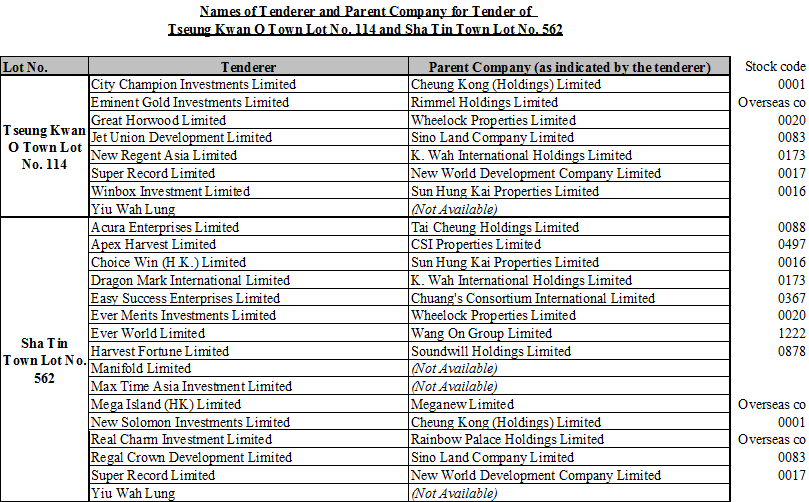
Much clearer, isn't it? Now we can see that Cheung Kong, K Wah, Sino Land, Sun Hung Kai Properties and Wheelock bid for both sites, while the smaller site in Sha Tin attracted smaller bidders, 5 of which are listed companies. In 3 cases, the parent companies were private and not incorporated in HK. We can't tell you where they were incorporated though, because amazingly, the Government doesn't collect that information. In every jurisdiction, company names are unique at any point in time, but two companies incorporated in different places can of course have the same name. So if you don't know the place of incorporation, then you don't know which company you are dealing with, just its name. So for example, we can't tell you who owns "Meganew Limited" or where it is incorporated.
Recommendations
Clearly there is a transparency problem here. Webb-site put the following recommendations to the Government by phone and in emails, that they should:
- Require in tender forms that each bidder (if a corporation) encloses a copy of its certificate of incorporation, stating its place of incorporation and company number.
- Require in tender forms that each bidder disclose the name of its ultimate parent company, if any, and enclose a copy of the ultimate parent's certificate of incorporation, stating its place of incorporation and company number.
- Publish, in the press release and Gazette, the names, places of incorporation, and company numbers of the bidders and their ultimate parents.
- Require bidders to disclose, by way of a diagram, the ownership structure of the bidder, down to the level of 10% interests. There can't be more than 10 such holders at each level, so that would not be difficult. An exemption could be made for parents which are listed companies, because we already have a law which requires disclosure at the 5% level of those.
The Government defends opacity
The Director of Lands responded by email as follows:
"The supply of the information about the tenderer's parent company (if appropriate) as provided for in the current Form of Tender would be sufficient for Lands Department. There is no intention to seek additional unnecessary information in the land sale by cash tender such as the shareholding structure of the tenderers, the places of incorporation of tenderers or their parent companies."
In other words "if we've got the cash, then we don't care where it is coming from". Such information is "unnecessary". By closing its eyes to the ultimate ownership of bidders and the humans behind them, the Government cannot be taking any steps to prevent money-laundering, something that it imposes great obligations on banks and estate agents to do. Well if they are worried about money-laundering using individual properties, then surely the same concerns apply to land transactions. Shouldn't the Government do its share, by requiring and publishing information from bidders on who is behind the anonymous shells? Particularly on smaller sites, the ultimate owner is often behind a private offshore company, not a well-known listed company.
As for the non-publication of the names of parents that they already receive, the Government's response was:
"As to the parent company of the tenderer (if applicable), the public may make a search at the Companies Registry for any available information in the register."
That's quite ridiculous, for several reasons. The Companies Registry only has information on companies registered in HK. A shell bidder does not have to be registered in HK. Even if it is, it is probably a new company that has not yet filed its first annual return, and even if it has, the information is behind a pay-wall and may be outdated (annual returns are only snapshots of shareholdings). Even if you can get that, it will probably only show that the registered shareholders are other intermediate layers of offshore companies, protecting the owners from disclosure.
So, having tried to resolve this privately with Government, we now go public, and call on the Government to implement the above recommendations.
It is frankly surprising that the Government cannot see the upside in greater transparency. Behaving in such a secretive manner only strengthens public perceptions that the Government protects and colludes with developers. What does the Government stand to lose by publishing the information? The public interest in land transactions with the Government, where public resources are at stake, demands an increased level of transparency as compared with private-sector transactions. Nobody has to participate in these tenders, but those who do should submit to this transparency.
Perhaps the Government is just embarrassed by the fact that for large sites, the parent companies of bidders come from a small group of developers who dominate the market and are the only ones large enough to bid. So by keeping their names off the written record, the illusion of greater competition can be maintained. Shell companies are different names every time.
Investors in listed companies would also like to know how active their company is in the land tenders, even if the bids are unsuccessful. It provides insight into the future path of those companies. For each tender since Mar-2012, we have been collecting that information, but you haven't. Shouldn't the Government publish it?
© Webb-site.com, 2012
Topics in this story
Sign up for our free newsletter
Recommend Webb-site to a friend
Copyright & disclaimer, Privacy policy