


Help the needy, not the needless
12 October 2012
Some members of the Legislative Council (you know who you are) are currently calling for a non-means-tested handout to anyone over 65, rich or poor. In other words, a universal pension. The debate is framed around Chief Executive C Y Leung's manifesto pledge of a means-tested Old Age Living Allowance (OALA) and makes reference to the existing Old Age Allowance (OAA), colloquially known as "fruit money", but if it is not means-tested, then it is a universal pension by another name. The legislators are threatening to veto OALA unless it is universal.
Universal benefits are a wasteful, untargeted and unsustainable approach to the allocation of Government resources. Last year, Webb-site ran the numbers on the cost of a universal pension (12-Mar-2011), based on population projections from the Census and Statistics Department. In twelve years' time, 2024, there will be 1.69m people over 65, up from about 0.98m at present. That will increase to 2.49m by 2039. Now let's look at what a $2,200 OAA would cost. First we need to estimate the current cost of elderly allowances, then deduct that from what a system with a universal OALA would cost.
What does the current system cost?
There are currently 3 mutually-exclusive options, in order of increasing value: OAA, Disability Allowance (DA), which is non-means-tested, and means-tested Comprehensive Social Security Assistance (CSSA). CSSA currently starts at the rate of $2820 per month (for an able-bodied singleton) plus an annual supplement of $1765, a combined total of $2967/month. Higher rates apply for those who are 100% disabled or in need of constant attendance. There are also "special grants" for various purposes.
Information on expenditure on these 3 items is sparse but we can piece it together.
- According to figures from the Social Welfare Department, at 31-Mar-2011 there were 508,070 people on OAA. That's been growing at about 10,000 per year, so we estimate there are now 523,000 at $1090/m, or $6.84bn per year, excluding frequent "one-off" bonuses dished out in budgets and policy addresses.
- According to a Legco answer, at 31-Mar-2011 there were 58,359 people aged 65+ on DA. There are two levels of DA, "Normal" and "Higher", currently at $1395/m and $2790/m respectively. According to SWD figures, about 12.8% of all DA recipients are on Higher DA. We will assume that is the same for those over 65. So we estimate the Normal DA costs $0.25bn and the Higher DA costs $0.85bn per year, for those over 65, a total of $1.10bn.
- According to another Legco answer, at 31-Mar-2010, there were also 187,128 other elderly aged 60+ on CSSA, and they cost $8.89bn, an average of $3,959 per month. That includes a one-off "bonus" month at the basic rate, but those are becoming the political norm and should be built into expectations. The numbers are not directly comparable to OAA, because CSSA defines elderly at 60+ rather than 65+ for OAA. Assuming that the CSSA age distribution mirrors the population, then about 71% of the "elderly" CSSA claimants are 65+, or about 133,000. The number of elderly CSSA cases has been stable over the last 5 years, so we'll assume the same number for 2012. Allowances have been inflation-adjusted since then by +9%, so the current annual cost is about $6.88bn, an average of $4315/m per person.
Altogether then, we estimate that the current cost of OAA, DA and CSSA for those aged 65+ is about $14.8bn.
What would a universal OALA (pension) cost?
If OALA is not means-tested, then all those on OAA and Normal DA would be switched to OALA to receive more money. Those on Higher DA and CSSA would stay there because the benefits are greater. As we noted above, the number of elderly CSSA cases has not changed materially over the last 5 years, despite the rising elderly population. That's partly because people retiring today are wealthier than those who retired in the past (for reasons see below). So we'll assume that the numbers of elderly 65+ on CSSA in 2024 and 2039 will be unchanged at current value of $6.88bn. We'll also assume that those on higher DA, about 0.8% of the elderly, increase in line with the elderly population. We'll also assume that 2% of the elderly population are economically irrational and simply don't collect the entitlement.
We therefore estimate the costs as follows:
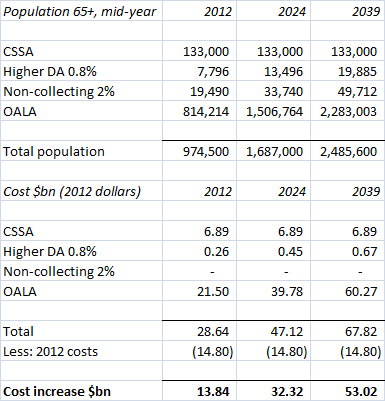
So compared with current expenditure, a universal OALA of $2,200 per month would cost an additional $32.3bn in 2024 and $53.0bn in 2039 (in 2012 dollars).
You might be thinking that population projections have often been wrong, but in this case we are really talking about the age distribution, and there is not much uncertainty surrounding longevity. If the absolute size of the population turns out to be wrong, then it is more likely to be at the young end of the bell curve (the birth rate and migration rate) rather than the old end, because old people weren't born yesterday.
And it could be worse...
Our expenditure estimate assumes that OALA keeps track of inflation (staying the same in 2012 dollar-terms). However, if the Government gives in now and makes OALA universal, then political pressures are likely to force up the handout faster than inflation. People would start to see it as a universal pension and then it would be criticised as insufficient to live on, even though a large number of recipients wouldn't actually need it. If the OALA was raised to say $4,300 per month, close to the current average CSSA level, then we can assume about 98% of the elderly population would collect it, at a cost of $85.3bn in 2024 and $125.7bn in 2039 (all in 2012 dollars). That's an additional $70.5bn in 2024 and $110.9bn in 2039 compared with current expenditure.
Impact on tax rates
The current GDP of HK (loosely, the money HK people and businesses make) is about HK$1,900bn per year, so spending an additional $53bn for a $2,200 universal pension would be equivalent to about 2.8% of GDP, a big increase in the cost of HK's Government, which historically has been around 20% of GDP. By comparison, the 2012-13 budget estimates that the total amount we expect to raise from salaries tax, property tax and personal assessment in 2012-13 is $56bn, and profits tax is estimated at $106bn, a total of $162bn.
Yes, GDP might grow a bit in the future, but there will be other demands on the Government, including the cost of healthcare for the elderly. So it is safest to budget based on the current situation.
Assuming a current average tax rate of 15% on income (after allowances), covering an additional $53bn of expenditure would result in tax rates going up by about 5%, so look for the profits tax rate to rise from 16.5% to 21.5% and the highest salaries tax rate to rise from 17% to 22% by 2039. Even by 12 years' time, 2024, a 3% tax increase would be needed, taking the profits tax to 19.5% and the salaries tax to 20%.
And if political pressure drives the universal pension up to $4300/month, then the additional cost would raise tax rates by about 6.5% for 2024 and 10% in 2039, so by 2039, profits tax would be 26.5% and the top rate of salaries tax would be 27%.
In reality, the rates would probably have to go higher than that, because as you raise rates, you drive away profits to friendlier jurisdictions. When the RMB is fully convertible (as it should be by then), if mainland tax rates are still at 25%, then who would want to shift their profits offshore to HK, as many do at present?
Yes, we do have substantial fiscal reserves and accumulated surplus in the Exchange Fund, currently about HK$1,239bn, but we can't depend on that indefinitely, particularly given the profligate way the Government has been spending on projects like the high-speed tube to Shenzhen ($60bn) and the HK-Zhuhai-Macau air pollution bridge ($49bn). Another 20 projects like that and we will be scraping the barrel.
Old does not mean poor
Whenever the TV stations talk about this subject, they tend to run B-roll footage of stooped old people pushing waste cardboard around, or living in caged homes, and this tends to reinforce a perception that all or most old people in HK are poor and needy. What they don't show you is retired investment bankers, lawyers, accountants, insurance agents, estate agents, stockbrokers, fund managers and doctors, who are unlikely to be poor, or civil servants on defined-benefit pensions, who will never be without income and normally have substantial savings too.
Any permanent civil servant who joined before 1-Jun-2000 will get a pension based on his pre-retirement income and length of service. According to a Government Answer to Legco, at 31-Mar-2011, there were 103,720 people receiving civil service pensions, and another 126,131 working civil servants on pensionable terms. The monthly cost was around $1,846m ($22.1bn per year), an average of around $17,800/month per existing pensioner. We can see no reason why such persons should receive an additional $2,200 per month in the form of a non-means-tested OALA. The 2012-13 budget estimates pension costs of $23.1bn.
Although the elderly population is rising, the percentage who are actually needy of CSSA will fall over time, and if we focus our resources on them, then the overall expense will be affordable, even if we raise the level of CSSA benefits. The percentage of elderly who are poor will shrink because the average lifetime earnings and savings of people retiring in the future will be substantially higher than those who worked in factories making shirts, plastic flowers and transistor radios in the 1960s and 1970s, often with only a primary education. They never had the savings capacity that many do today.
Take a look at this table of educational attainment from the 2011 census. It's raw numbers, but we'll save you the maths. From this we calculate that in 2011, only 4.6% of those aged 65+ had a (university) degree, and only 16.6% got beyond lower secondary school before heading to work. A stunning 73.6%, almost three quarters of our elderly population, didn't get beyond primary school. Almost all of them were born before or during World War II.
But for people aged 50-64 who will reach retirement age in the next 15 years, 8.4% have a degree, and 35.8% went beyond lower secondary school. Then look at the cohort aged 35-49, retiring from 2027-2042; 20.9% of them have degrees, and 63.2% completed upper secondary school (Form 5), sixth form, or higher. Only 16.1% didn't go beyond primary school, probably including many migrants from the mainland. With their education, and HK's economic prosperity in the last few decades, goes higher income. So the retirees of the future will overall be progressively better off and less needy.
How did we get in this mess?
Successive administrations since 1997, particularly Donald Tsang's, have been indiscriminate in their approach to welfare, outlaying large budget surpluses in a haphazard manner and gradually building up an expectation that they will continue to do so. It's an aspect of the creeping socialism, central planning and intervention which is undermining the capitalist foundations of HK's economic success, but it is not too late to stop it. We don't have to end up like Greece or Spain.
In the case of OAA, Donald Tsang got the ball rolling on 15-Oct-2008 by proposing to raise the OAA to $1,000, but with a means test. At the time, the OAA was $625/m for those aged 65-69 (with a means test) and $705/m for ages 70+ (without a means test). So he was proposing a 41.8% or 60% increase for those who needed it. Those already over 70 who could not pass the means test would continue to receive the handout at the old rate, because they didn't need it. There ensued a famous incident in Legco in which the League of Social Democrats threw fruit at the Chief Executive, and 9 days later, he caved in, "shelved" the means test, and increased the allowance to $1,000/m for everyone, including those who didn't need it, which took effect on 1-Jan-2009, raising annual expenditure by $1.765bn (plus bonuses). Since then, the allowance has been adjusted for inflation to its current $1,090/m.
C Y, stand your ground and reform CSSA
Where C Y Leung really messed up was by proposing this new layer of means-tested benefits in the first place, part of an election game in which Henry Tang countered with an even higher offer of $3,000. We already have the CSSA system for means-tested benefits. There are problems with it, because qualifying involves assessing the entire household income, and often obtaining confirmation of the level of support (or confirmation of no support) from children, the so-called "bad child" letter. But rather than fix the problems with CSSA, the Chief Executive has proposed a patch-up job in the form of OALA.
CSSA should be modernised. The "bad child" letter can be scrapped, in favour of a simple declaration of income and assets of the individual or couple. Lying about that will still be a criminal offence. Asset thresholds should rise. Currently you have to be down to your last HK$24,000 of assets to qualify - but many people want a cushion to pay for their funeral, whilst still scraping by on minimal income. For an elderly person, the asset threshold should be raised to a more humane level, perhaps HK$100,000 for a singleton.
If C Y Leung had only been talking about raising the benefits and modernising CSSA, then nobody would be suggesting removing the means test. But because he has proposed OALA, which sounds like the existing OAA, he has paved the way to another political crisis. That said, he should now stand his ground. If legislators vote down the OALA proposal, they would be doing him a favour, because they will give him a chance to do a proper overhaul of the elderly CSSA system. He should then immediately establish a commission to review the elderly CSSA system, its assessment process and its benefit levels. It should probably also be rebranded to remove any stigma that the old CSSA has accumulated. We suggest the "Modern Elderly Allowance for Needy Seniors", or MEANS, as it would be means-tested. No doubt a catchier Cantonese name can be devised.
If we have proper means-testing, then benefit levels for the needy can rise too. Put simply, we can afford to do more for the needy if we don't throw money at the needless. At the same time, he should do what Donald Tsang failed to do, and stop dishing out $1,090 per month to anyone who can't pass the means test. The truly needy should get a reformed CSSA level of benefits, not $1,090 per month.
A proper means test
One of the bizarre aspects of the existing means test for OAA, which is the same as the proposed means test for OALA, is that it excludes a primary residence from assets - so we are paying welfare to people who could otherwise sell their home and rent a similar one with part of the proceeds, or they could get a reverse mortgage and stay in the home for the rest of their life while collecting monthly payments from the HKMC. We really shouldn't be paying welfare to people who own property. They are not poor, just illiquid, and they can resolve that by liquidating their main asset.
The OAA/OALA means test also ignores the support of family members. So if you live in a $3m flat and have less than $186,000 of cash savings (or $281k for a couple), and your family is supporting you with monthly payments (and getting a tax allowance for doing so), you can still get the proposed OALA. When you die, your family inherits the $3m property. In effect, the OAA or OALA comes right back to them. Example: retire at 65, live to 85, and collect OALA for 20 years at $2,200 per month. Use that and your family's support to live off, without touching your home, and your estate will be $528,000 better off when it passes to your children, who will also have received a tax break. How is that a good use of taxpayers' money?
By comparison, the CSSA has a proper means test, where income and assets from all sources is counted. That is as it should be, but we can certainly raise the thresholds and simplify the application process.
$2 fares
It's not just the higher OAA where this scattergun approach exists. On 28-Jun-2012, the HK Government began rolling out a Public Transport Fare Concession Scheme (PTFCS) which is another example of its wasteful and untargeted approach to welfare. Any person over 65, rich or poor, will now be entitled to take public transport for a nominal HK$2 (US$0.26) per journey, subsidised by taxpayers. We wonder why they bother charging at all. And that is any time of day, not just off-peak times. So old security guards, already benefitting from a Work Incentive Transport Subsidy (WITS) of $600/m, will now be able to get to work and back for just $100/m (assuming 25 days x $4) and pocket the other $500/m.
WITS, by the way, is another misguided scheme which started in 2007 with good intentions to compensate low-income workers who are forced to live in remote public housing and commute to work, but now it has morphed into a subsidy for all low-income workers, including city-dwellers, negating the compensatory effect. Instead, it gives employers an effective subsidy - they can pay less and still get people to come to work. And WITS has yet another version of means test, which excludes a self-occupied property from assets, but includes support from family in the household income test.
Back to the PTFCS. In a paper submitted to a LegCo meeting on 14-May-2012, the Government itemised a list of eligible routes. These include all the MTR lines except: the Airport Express, journeys to the border at Lo Wu and Lok Ma Chau, and the Shatin Racecourse (if you can afford to go abroad or gamble, then you can afford the rail fare). We predict a boom in domestic courier services staffed by seniors.
The subsidy also includes all the domestic ferry services, including the route from Central to Discovery Bay, home of a huge single-developer private estate and no public housing. Anyone who can afford to live there doesn't need taxpayers to subsidise their transport. Retirement to Discovery Bay just became a whole lot more attractive.
The regular 1-way fare is $33.80 for adults and $16.90 for seniors aged >=65, so there is already a cross-subsidy between passengers below and above 65. By buying "stored points" in a proprietary "Transport Card", frequent users can get the price down to $27.97 for adults and $14.03 for seniors. Now the Government will subsidize most of the rest, reducing the senior fare to $2, a saving of 85.7% even for the lowest existing fare of $14.03. Between midnight and 6 a.m., the savings will be even greater, as the lowest senior fare overnight is currently $27.21. But seniors should be tucked up in bed with a whisky at that time of night, so we will ignore the overnight fare saving.
Even so, a person aged 65, commuting 5 days a week to central to continue a job or visit friends, would normally pay at least $140.30 per week and will now pay just $20. Over a 48-week year, allowing time for holidays, that would come to a saving of $481.20/month.
Who does this help? Well it helps:
- landlords and property owners in Discovery Bay, because the transport costs of living there just became a lot less for a large number of people. That is likely to push rents up, absorbing a lot of the transport savings that an elderly tenant might achieve. With rents up, the value of property goes up too. Retirees who already own property there will get a double boost - subsidised fares, and higher property value.
- the developer, Hong Kong Resort Co Ltd, which is 50% owned by HKR International Ltd (HKR, 0480) and 50% owned by CITIC Pacific Ltd (CITIC Pacific, 0267), to the extent that it can develop the resort further, perhaps by boosting the plot ratio. It was reported in 2008 to be seeking to double the plot ratio to 0.36.
- the operators of the ferry, because when you cut the user's price of something by 86% then you are bound to increase demand. In this case the ferry is operated by Discovery Bay Transportation Services Ltd, owned by the developer.
- tenants aged 65+, to the extent that their rent (if any) increases by less than their transport savings.
The Government estimates the cost of the $2 fare scheme system-wide at HK$400m in the first full year, but that will grow over time as the number of elderly increases. The Government's estimate is also too low - they admit in their paper that they "have not factored in additional patronage which may be induced by the Scheme". Still, taking their figures and using their population projections, we estimate that would cost $690m in 2024 and $1.02bn in 2039, all in 2012 dollars. This is just plain silly. If we took that $400 million in 2012, and allocated it to each of the 133,000 seniors over 65 on CSSA, then they could have an extra $3,000 per year or $250 per month. Why spread it across the entire 980,000 elderly population?
© Webb-site.com, 2012
Topics in this story
Sign up for our free newsletter
Recommend Webb-site to a friend
Copyright & disclaimer, Privacy policy