


Xpress excess
8 October 2012
Sitting in a panel session on executive pay in a Singapore conference last Tuesday (2-Oct-2012), while HK was taking time off for National Education Day, the following HK case sprang to your editor's mind, and he resolved to write it up when he got home. Xpress Group Ltd (Xpress, 0185) is a clear demonstration of the excessive executive pay that can occur under HK Listing Rules when the director is also a substantial or controlling shareholder. Never heard of the company? Well just bear in mind that it could happen to yours too.
Option grant
Back on 17-Aug-2010, a circular went to independent shareholders asking them to approve the grant of options over 400m shares (15.15% of the existing issued shares) to "retain" and "incentivise" the "Managing Chairman" and majority shareholder, Ambrose Chan Heng Fai (Mr Chan). Mr Chan and his family already owned 66.24% of Xpress. Webb-site has never met a controlling shareholder who lacked incentive to run his company. Any controlling shareholder already has a strong financial interest in the success of the company, and controlling shareholders simply don't get "poached" to leave the company they control and go and run someone else's company.
The Listing Rules allow grants of options to substantial shareholders up to 0.1% of the outstanding shares, or HK$5m of exercise value, whichever is higher, per year. Beyond that, you need independent shareholders' approval. Mr Chan's option grant was 151 times that number, and the underlying shares, at $0.134, had a subscription value of HK$53.6m.
Independent Financial Adviser Chanceton Capital Partners Ltd (Wong Kam Wah) saw nothing wrong with this, and the three wise INEDs Peter Wong Dor Luk (Peter Wong), Joao Paulo Da Roza (Mr Da Roza, deceased 16-May-2011) and Aston Wong Tat Keung (Aston Wong), an accountant, agreed that it was fair and reasonable. Two of them, Mr Da Roza and Peter Wong, were also members of the Remuneration Committee at the time, and Aston Wong replaced Mr Da Roza subsequently. Incidentally, in the death notice, Xpress eulogised Mr Da Roza's "lofty professionalism" and "outstanding contributions...in promoting standardized corporate governance and protecting the interest of the Company and its shareholders as a whole".
At the EGM, the total number of votes cast was 25,476,849, only 2.96% of the 861,319,086 shares held by independent shareholders. This again highlights a huge problem - retail banks and brokers, who hold shares on behalf of their customers, are not required by their regulators to seek voting instructions from customers. So most investors were blissfully unaware that they had an opportunity to vote this down. Only 290,005 shares voted against. The proposal was passed with a 98.86% majority of votes in favour, but that was only 2.92% of the eligible shares, and only 0.95% of the issued shares. Xpress probably has no institutional shareholders, because they tend to vote through their custodians.
Note to regulators
When you have such low
voting turnouts in shareholder meetings, the whole system for connected
transactions fails, because it is always possible for a few employees, friends
of management or relatives (other than a spouse and minor children), to push
through a bad proposal. As we've said many times, the SFC and HKMA should
require bank and brokers who hold client stock to seek their voting instructions
for every shareholder's meeting. Those banks and brokers who don't want to do
the work can instead open a
Stock Segregated Account with Hong Kong Securities Clearing Co Ltd (HKSCC)
for each client, so that they can receive notice of meetings from HKSCC and vote
their stock through HKSCC.
Service contract
If you thought the option grant was excessive, you ain't seen nothin' yet. The options circular failed to give a full picture of Mr Chan's remuneration arrangements which would have put the proposal in context. In particular, at that time of the EGM to approve the options (2-Sep-2010) it had not yet been disclosed that on 29-Jan-2010, Xpress entered into a service contract with Mr Chan commencing 1-Feb-2010, under which he would be paid an annual salary equal to 5.9% of the net assets value as shown in its consolidated audited accounts at each financial year end (plus an accommodation allowance of $30k per month).
This was a huge increase in his pay. In the year to 31-Mar-2010, he was paid an already-generous $5.524m. The net assets at 31-Mar-2010 were HK$772.7m, so 5.9% of that would be $45.59m, more than 8 times the previous year, plus the value of the options. The service contract was not known to shareholders before voting on the options. The contract is outrageous by any measure - he gets a percentage of net assets, whether or not the company makes a profit, and if it raises new funds, he gets a percentage of that too. Every year. Even if Xpress were an investment fund, and Mr Chan were its only fund manager, a 5.9% management fee would be excessive. The contract lasts 3 years. If there is no other change in net assets per share over that time (i.e. no net overall gain or loss), the compound rate of fee will reduce net assets by 1-0.941^3 = 16.7%, or one-sixth, over that period. In a 10-year period, it would drag net assets by 1-0.941^10 = 45.6%.
Despite this, the circular contained the required responsibility statement from each director and stated that:
"The Directors, having made all reasonable enquiries, confirm that to the best of their knowledge and belief the information contained in this document is accurate and complete in all material respects and not misleading or deceptive, and there are no other matters the omission of which would make any statement herein or this circular misleading." (our bold)
We regard the omission of Mr Chan's new service contract from the circular as very material. If investors had known how much he stood to gain under the new contract, this would have been a very material factor in deciding whether he should also have such a large slug of options. Not only that, but the contract was so large relative to the company's finances, that in our view it should have been announced when it was signed on 29-Jan-2010, as negative price-sensitive information under Listing Rule 13.09. It follows from this that the statement that there are "no other matters..." was itself false and misleading, and we have urged the SFC to investigate this in a complaint filed on 2-Jun-2012. Several (if not all) of the directors would or should have had direct knowledge of Mr Chan's service contract, including Mr Chan, his wife, and the two INEDs who served on the Remuneration Committee.
The regulatory position on service contracts
Directors' service contracts, being the provision of services to a company by a connected person, are connected transactions, but under Listing Rule 14A.31(6), they are exempt from the announcement and independent shareholders' approval requirements, even if that director is a substantial (10%) or controlling (30%) shareholder, and regardless of how excessive the provisions are. This forms a giant loophole in the rules. The only exception (for contracts signed since 1-Feb-2004) is that under Listing Rule 13.68, if the contract may last more than 3 years, or if it requires more than 1 year's notice or 1 year's pay to terminate, then it must be subject to independent shareholders' approval. That's why Mr Chan's contract lasts 3 years and requires 1 year's pay or notice to terminate, the maximum allowed without approval.
Note to regulators
The Listing Rules are
clearly inadequate, as the Xpress case demonstrates. In our view, if the
director is also a substantial shareholder, then service contracts, initial pay
packages, and increases
in pay beyond a reasonable speed limit (say,10% per year), should be subject to
independent shareholders' approval.
You may be wondering, what about the much-vaunted Remuneration Committee, which became mandatory under Listing Rules on 1-Apr-2012 (this was not a joke, or at least it wasn't meant to be). Well yes, Xpress has had one since 2005, and obviously, this did not stop Mr Chan being hideously overpaid.
And why are HK Remuneration Committees generally ineffective? Investors should remember that in a controlled company, the controlling shareholder effectively determines the membership of the entire board, including the "independent directors", by voting in all the elections in shareholder meetings. We explained that in detail in our article "The three wise monkeys of HK boards" on 15-Feb-2011. So whatever committees you put INEDs into, it makes no difference if they aren't truly independent to start with. They are only as independent as the controlling shareholder wants them to be.
Note to regulators
Unless independent
directors are elected (and removable) only by independent shareholders, with
controllers abstaining, the INEDs cannot be truly independent. Controllers could
still nominate candidates with whom they feel they can work on the board, but
the candidates should be subject to approval by independent shareholders. If
regulators are not willing to make that Listing Rule change, then they should stop
this charade, and drop the requirement to have INEDs at all. Instead make a rule
that you cannot call anyone an INED unless the controlling shareholder and
executive directors, as shareholders, have abstained from voting on the election
of the INED in general meeting.
Disclosure of Mr Chan's service contract
The service contract was first disclosed almost by accident. Xpress announced a "Major Transaction" under the Listing Rules, and as a consequence it had to produce a circular, and that circular dated 17-Sep-2010 had to include details of any service contracts which were not terminable within one year without payment of non-statutory compensation. So, deep in the circular, on page 6 of Appendix II, you will find a brief summary of Mr Chan's contract, by then 7 months old. This also means that the contract was briefly "available for inspection" at the company's office in HK until the EGM on 4-Oct-2010, but under HK's archaic Listing Rules, these documents do not have to be filed online, nor kept available after the EGM. To put them on display in this way is really a sham form of disclosure.
Note to regulators
As we've
said before, the Listing
Rules should be amended to require that all "documents available for inspection"
are filed on the central web site for listed company disclosures (currently at
HKEx), and are kept there forever, not taken down after a few days. If something
is important enough to be disclosed, then it should not be hidden in a physical
office and then withdrawn.
The outcome
Mr Chan's total remuneration was HK$64.62m in the year to 31-Mar-2011, and $54.19m in the year to 31-Mar-2012, a 2-year total of $118.8m. That absorbs the bulk of the gross profits of the group, which were $67.27m in 2011 and $72.58m in 2012, mostly from rental income on investment properties, and hotel operation. After tax, the group made a profit attributable to shareholders of $45.42m in 2011 and a loss of $156.4m in 2012, a net 2-year loss of $111.0m. You can ascribe that loss almost entirely to the excessive remuneration of Mr Chan.
A history of excessive pay
We should note that this is not the first time Mr Chan has had an unusual contract. Way back on 1-Oct-1992, he signed a 5-year contract with Xpress as Executive Director, for a potentially lucrative 20% of net operating profit before tax (if any). That didn't work out though - Xpress made a loss every year until from then until 1995, so it was replaced with a contract effective for 5 years from 1-Nov-1995, under which he would receive a not-unreasonable HK$100k per month on a 13-month basis, subject to an annual increase of at least 10%. At the same time, his wife Chan Kong Yoke Keow (Mrs Chan) was contracted for 5 years at $80k on a 13-month basis, again with at least 10% annual increase. The couple each had the right to terminate on 180 days' notice, but there was no mention of any such right for Xpress, which would presumably have to pay for the full 5-year contract.
Xpress continued to make losses, but on 1-Feb-1997, 15 months after the previous contract, Mr Chan swapped it for a new 5-year contract on a tripled salary of HK$300k x 13 months, again with at least a 10% annual increment, which would have increased it to at least $439k per month for the 5th year. This time, the annual report stated that if Mr Chan's employment was terminated by Xpress following a change of control of the company, or for any reason not specifically excluded, then the full 5-year amount was payable. On the same date, Mrs Chan was given a 5-year contract on similar terms starting at $88k x 13, plus a housing allowance of $30k per month.
But that wasn't enough either. Just 6 months later, on 1-Aug-1997, Xpress and Mr Chan supplemented his contract, extending it out to 31-Jul-2007 (a ten-year contract from then) and tripled his pay again to $900k x 13, or $11.7m per year, and not only that, but he would also get a bonus of 8% of pre-tax profits, if any. Assuming the 10% escalator remained in place, by the 10th year his basic salary would be $27.59m, plus the profit share. By comparison, at 31-Mar-1997, Xpress had shareholders' funds of just $133.5m.
But wait, that's not enough either. 6 months later, on 1-Feb-1998, perhaps realising that the way he was running Xpress, it was unlikely to make much profit, they supplemented the contract again, making the salary either 101% of the previously-agreed amount, or 5.9% of the net assets at each financial year end, whichever is higher. At the same time, Mrs Chan's contract was also supplemented, making her salary either 110% of the previously agreed amount, or 1% of net assets at each financial year-end, whichever is higher. So the couple together would get 6.9% of net assets per year, whether or not the company made a profit. They knew by then, after a series of placings during 1997, that the net assets would be the driver of this formula. Net assets at 31-Mar-1998 were $397.1m, so 6.9% of that would imply combined salaries of $27.40m for the following year, plus Mrs Chan's housing allowance.
On 9-Nov-1998, Mr Chan's contract was replaced with a new, shorter contract, dialled back to 5 years and deemed effective from 1-Feb-1997, expiring 31-Jan-2002. This still gave him the same salary arrangement from 1-Feb-1998, plus a housing allowance of $30k per month, as if he needed it. On 25-Nov-2000 with 15 months remaining, Mr Chan's contract was extended by 3 years to 31-Jan-2005.
On 22-Apr-2002, Mrs Chan signed a new contract, replacing the expired one, for 5 years to 1-Feb-2007, on the same terms as before. The 2004 annual report mentions that for 12 months from 1-May-2002, she "voluntarily received only 75%" of her pay under the contract. That still earned her between $4.5m and $5.0m in the year to 31-Mar-2003 (pay was then disclosed in bands).
On 22-Aug-2003, Mr Chan gave a "Voluntary Undertaking to Reduce Basic Remuneration by Approximately 50% effective August 1, 2003" and "requiring any additional remuneration to be subject to the Company's profit before taxation". Although it didn't say on what basis it would be "subject", it did say that the total remuneration would not exceed the previous arrangement. This apparent munificence initially made no material difference to pay - the executive directors were paid $33.23m in the year to 31-Mar-2004, compared with $31.33m the previous year. That includes 2 of their children, who were on modest stipends.
There was a dip in the year to 31-Mar-2005, when Mr Chan was paid $15.0m, but then, on 22-Feb-2005, Xpress and Mr Chan signed a new 3-year contract to 31-Jan-2008 for HK$2.1m per month ($25.2m per year), plus $30k of housing allowance. Under the new Listing Rules which took effect in 2004, the new contract was limited to 1 year's pay in the event of termination by the company.
On 3-Jul-2007, Mr Chan signed a new contract for 2 years from 1-Feb-2008 to 31-Jan-2010. This provided a nominal salary of $185 per month (the same as the stock code), plus a housing allowance of $160k per month. On 20-Nov-2008 the allowance was reduced to $30k per month effective 1-Nov-2008. Meanwhile, Mrs Chan's contract expired on 31-Jan-2007 but continued on a "month-to-month basis" to pay on the same formula as before.
15-year total
Under HK Listing Rules, directors pay has been disclosed in annual reports on a named basis since 2005. In the 8 years to 31-Mar-2012, Mr & Mrs Chan were paid a total of $268.2m (of which Mr Chan was paid $216.7m), while the total profit attributable to shareholders over that period was just $60.4m.
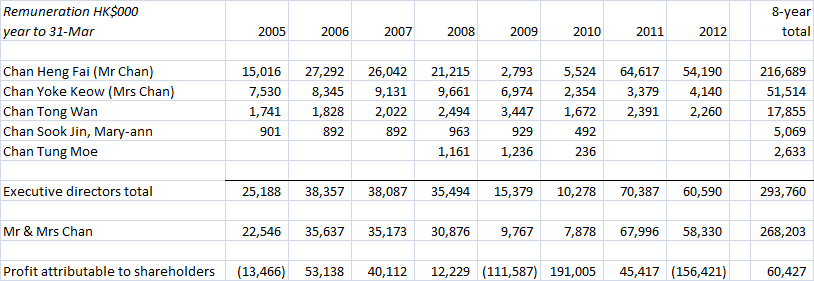
Going back further, in the 7 years to 31-Mar-2004, the Executive Directors were paid $206.0m, while the net loss attributable to shareholders was $307.9m. The only EDs during that period were Mr & Mrs Chan and their children, but it is clear from the pay bands that the vast majority went to Mr & Mrs Chan, with one child earning between $1.0m and $1.5m in 4 of those years and otherwise below $1m each.

Taking the 15 years together, the Chan family has taken pay of $492.8m, and the total profit attributable to shareholders was...well, there wasn't any. It was a total loss of $247.5m. And let's be clear, none of this pay was a breach of the Listing Rules - because the Listing Rules contain no constraints on such atrocious behaviour. During the same 15-year period, the Webb-site Total Return on the shares was -69.15%.
© Webb-site.com, 2012
Organisations in this story
People in this story
- Chan Kong, Mabel Yoke Keow
- Chan, Ambrose Heng Fai
- Da Roza, Joao Paulo
- Wong, Aston Tat Keung
- Wong, Kam Wah (SFC:AEZ347)
- Wong, Peter Dor Luk
Topics in this story
Sign up for our free newsletter
Recommend Webb-site to a friend
Copyright & disclaimer, Privacy policy